
Toutes mes réponses sur les forums
-
AuteurMessages
-
Il y a maintenant des bustes d’HCM partout même dans le temple des ancêtres de tous les villages alors on en a un peu raz-le-bol.
Je n’ai jamais entendu de nom particulier.
il y a juste la cérémonie de déterrement 3 ou 4 ans plus tard qu’on appelle BOC MOC’est un cochon Halal ?
Où peut on signer une pétition pour supporter les villageois ?
ils ont récupéré ça sur Yahoo Inde bien sûr beaucoup de végétariens sont choqué. Mais un lecteur a mis le commentaire suivant : Autrefois, on faisait des sacrifices humain…
For Indians this is nothing, animal sacrifice for pleasing INDIAN GODS is an age old tradition, people go to the extent of making HUMAN sacrifice,,, dont show it in yahoo
 10 mars 2012 à 10h29 en réponse à : Quang Yen en baie d’Along est-ce la même chose que l’ile où se trouve le cimetière marin #147519
La ville de Quang Yen est à l’embouchure d’un bras du Fleuve Rouge, c’est une ville moyenne ; c’est la dernière ville avant Hai Phong.
hihi, avons fait la liaison Halong – Dong Trieu (la dernière ville sur la route de Hanoi avec une L300 Nissan à moteur Toyota mais le collègue qui faisait Halong QuangYen avait le record du minibus pourris ; je crois que c’était un résidu d’épave d’ambulance russe UAT mais repeint en blanc avec une bande bleu, ça le faisait ! enfin dans les année 90. Une fois il a perdu une roue alors les clients se sont plaint au journal Lao Dong et son taxi a eu le droit à une foto dans le journal avec un article dont le contenu était : Halong – QuangYen : 50 km mais parfois marcher à pied vas plus viteA Quang Yen, il y a un grand marché où on trouve des truc qu’il n’y a plus à Halong
A coté du marché, il y a une base militaire de la marine mais c’est très ancien ; il n’y a pas de port. je pense que c’était là le cimetière.
Il y a l’ïle de Ha Nam et ses villages de pêcheurs.
Maintenant, il y a un grand pont qui traverse le fleuve ; de l’autre coté, c’est des Sudistes, je ne parle pas la langue, ça me fait mal à la tête ; c’est une ville qui s’appelle Saïgon ou Haiphong ; on mange bien mais la bière est dégueulasse.Si elle a un wiki, en plus elle est très jolie ; mais Robinson est un faux nom
hou la la ! c’est vraiment de la litérature de Viêt công !
Marie Nyswander – Wikipedia, the free encyclopedia

Marie Nyswander (March 13, 1919 – April 20, 1986) was an American psychiatrist and psychoanalyst[1] known for developing and popularizing the use of methadone to treat heroin addiction.Nyswander was born on March 13, 1919, in Reno, Nevada. Her father, James Nyswander, was a mathematics professor and her mother was noted health educator Dorothy Bird Nyswander; they divorced soon after her birth, and Nyswander followed her mother to Berkeley, Salt Lake City, and New York City. Her original name was Mary Elizabeth Nyswander; she took the name Marie as a teenager.
Nyswander graduated from Sarah Lawrence College in 1937 and trained as a physician and surgeon at the Cornell University medical school until 1944; while at Cornell, she was briefly married to anatomy instructor Charles Berry. After finishing her studies at Cornell, she attempted to join the Navy, but discovered that they did not allow women to serve as surgeons. 😆 notaDD: Ca c’est du Viêt Công !
Despite a life marked by many changes, Marie Nyswander, MD, seems destined to have become a leader in the addiction treatment field.
Her straightforward manner, her unsentimental compassion, and her easy rapport with patients were legendary. Most important, at a time when her fellow psychiatrists viewed drug-addicted persons with disdain as being mentally-deficient moral outcasts, she promoted the idea of addiction as a disease.
It is commonly recognized that no other American psychiatrist of her generation benefitted the lives of so many opioid-addicted patients.
Addiction as a Medical ProblemMarie was born Mary Elizabeth Nyswander (which she later changed to Marie) in Reno, Nevada, in 1919. Her father, James, was a mathematics professor and her mother, Dorothy, earned a doctorate in psychology after the couple’s divorce when Marie was still a toddler.
Marie was raised by her mother and the two eventually moved to New York City in 1936. Marie attended Sarah Lawrence College and later went to Cornell University Medical College, graduating in 1944.
After completing a surgical internship, she joined the Navy as a surgeon. However, the Navy had no place for female surgeons in those days and Nyswander was posted to the Lexington Narcotic Hospital in Kentucky run by the U.S. Public Health Service.
The Lexington experience was a turning point. Nyswander saw drug addicts from all walks of life branded as psychopaths, mistreated, and subjected to racial insults. She became convinced that these patients could and should be treated more humanely, as individuals.
When she left the service, Nyswander decided that surgery was not for her and pursued a career in psychiatry. She trained at New York Medical College in the late 1940s and established a private psychiatric practice in the early 1950s.
She volunteered much of her time treating impoverished drug-addicts and, in 1955, Nyswander helped establish the Narcotic Addiction Research Project — a first of its kind outpatient program providing actively addicted patients with intensive individual psychotherapy. She also set up a clinic to treat jazz musicians addicted to heroin and by the early 1960s was treating addicts in an East Harlem storefront clinic.
Nyswander described her clinical experiences in a book, The Drug Addict as a Patient (1956). Her patients’ repeated cycles of brief recovery inevitably followed by drug relapse were frustrating, yet she believed they could be helped by clinicians willing to learn more about addiction. She presented a radical viewpoint, at the time, that addiction should be approached from the perspective of patients with a medical problem.
Nyswander’s empathy with patients may have been influenced by her self-acknowledged addiction to nicotine; she was a 3-pack-a-day smoker. In Nat Hentoff’s excellent book on her work, A Doctor Among the Addicts (1968), she tells of once attempting to quit: “The craving for cigarettes exists as an entity, separate from pleasure. Nor did the craving diminish with time. …if it’s this hard to stop smoking, think what it must be like to stop taking a drug such as heroin.”
Birth of MMTAnother turning point came for Nyswander in the early 1960s when she was invited to join Vincent Dole, MD, at Rockefeller University in New York City. He was embarking on a project exploring new pharmacotherapies for opioid addiction and had read Nyswander’s book. He believed she had the necessary skills and experience in working with drug-addicted patients. In 1964, a third member joined the team – Mary Jeanne Kreek, MD – who was a young clinical investigator and first year resident in internal medicine.
After testing a number of agents, the team soon discovered that methadone stemmed withdrawal and relieved narcotic hunger, yet at stabilized doses it did not produce the euphoria of other opioids. By spring 1965, the team had data on 22 patients successfully treated with methadone and published their remarkable findings. Expansion of their program and further publications soon followed, giving birth to the methadone maintenance treatment field.
Essential Lessons; Seeing the Inner PersonAccording to Mary Jeanne Kreek – who is now Professor and Head of the Laboratory of the Biology of Addicted Diseases at Rockefeller University – Nyswander was intense and rather firm at times. However, she was always open-minded when it came to discussing individual patients and their treatment.
“Many therapists and clinicians would dismiss what patients were saying as the ramblings of disturbed, addicted minds,” Kreek notes. “Yet, Marie reminded us again and again, ‘listen to the patient.’”
“Marie felt that much could be learned by careful listening,” Kreek says. “Then, if the whole story was not forthcoming, patients could be questioned.”
A major new concept of the team was viewing addiction as a brain disease. Patients should not be defined by their past behaviors and merely viewed as criminals or weak-willed. “Marie knew that behavior management alone was insufficient to deal with addiction,” Kreek continues. “However, the notion of using pharmacotherapy, such as with methadone, to treat the drug-addicted brain was a new idea and slow to catch on.”
In 1965, Nyswander married Vincent Dole, and she passed away in 1986 at the age of 67. Each year since 1983 the Nyswander-Dole Award created in their honor – and now simply known as “The Marie Award” – has been bestowed on individuals who have made outstanding contributions to the methadone treatment field.
Looking back, Dole once remarked that her secret was an ability to see the inner person. No doubt, such vision was aided by better listening to patients.
C’est très bizarre : Je vénère ces livres là depuis très très longtemps, des dizaines d’années et je n’avais jamais googelisé les auteurs.
C’est très dröle : les 2 n’ont pas de wiki alors…
Je nèavais ni le nom, la préface et la dernière page de l’autre…hou la la, jai eu très peur ! jene separe jamais ces 2 livres là.
‘est mon butin de KM0
mais le 2eme, je n’ai ni la couverture, ni la reliure alors il s’égare facilement
J’avais très peur de l’avoir perduJe le google pour la 1ere fois
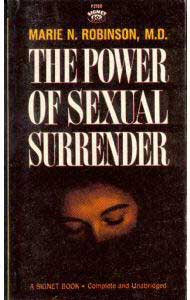
« The Power of Sexual Surrender », by Marie N RobinsonThis book has long been out of print, but it is available from: Alibris: Used Books, Used Textbooks, Rare & Out-of-Print Books Amazon also has a few used, but those are costly.
Dr Robinson says that frigidity in women often results from refusing to submit to the common female fantasies regarding male domination. Dr Robinson held a degree in psychiatry from Cornell University, and ran a clinic in Manhattan (NYC) specializing in the treatment of female frigidity.
‹ A man sometimes needs his taken in hand wife to be strong How do you maintain control without discipline? ›
A readers’ forum post by BlueRose on Mon, 18/07/2005 – 17:27I am still reading this book…
am almost done. Its a sad shame its out of print because I think a lot of women could be helped by it, whether they admit it or not. I found out the truth of what Dr Robinson says on my own, after I adopted the Taken In Hand philosophy…but its good for me to read her book and see my personal experiences of late being confirmed. I thought maybe there was something wrong with me, but I find out I’m normal (at least by Dr Robinson’s orthodox Freudian theories.)
Je crois que le 2eme livre que jai trouvé dans la bibliothèque de KM0 va faire plaisir aux dames :
The Power of Sexual Surrender
Je n’ai pas la couverture et maintenant, je comprend pourquoi : C’est les Viêt Công qui apprennent l’anglais
Author: Marie N. Robinson, M.D.The bond of a wonderful sex life is unbreakable. Never before have men and women found themselves in a better position to explore together the infinitely varied and rich potentialities of lovemaking. Yet despite all the possibilites open to them, millions of women still find themselves unable to reach orgasm. Marie Robinson, a renowned psychiarist, has helped countless women to achieve the sexual maturity that is so necessary for a rich and vital marriage. Among the many topics she frankly discusses are: the psychology of female orgasm, dangers on the road to womanhood, the nature of surrender and the lore of love.
ISBN: 214194
Publication Date: 1962je n’avais pas la couverture de ce livre… et pour cause
Le mien est partiellement traduit en vietnamien (les mots difficiles)
Pages: 1891 des 2 livres que j’ai trouvé dans la Bac Bo Phu est : L’acte Essentiel
Charles Fouqué (1889)Charles Fouqué, né à Cherbourg en 1889, décédé en 1965, est une personnalité de la Manche.
Les Études psycho-sexuellesLe docteur Charles Fouqué est, avant la dernière guerre, un des pionniers de l’éducation sexuelle en France et il se rend très célèbre en publiant une série d’ouvrages populaires sur la question.
Charles Fouqué fait ses études à Avranches puis à la faculté de médecine de Lyon. Après la Première Guerre mondiale au cours de laquelle il est gazé à l’ypérite, il vient s’installer comme médecin de campagne à Saint-Pierre-Église avant d’ouvrir un cabinet rue Bondor à Cherbourg où ce père de neuf enfants, fervent sportif, s’adonne avec passion à la boxe, à l’escrime et au rugby. Il ne fait alors que mettre en pratique sa propre philosophie selon laquelle la culture du corps et celle de l’esprit doivent aller de pair pour atteindre l’équilibre. Il quitte sa ville natale en 1930 pour aller exercer à Lyon. On parle beaucoup de lui en 1955 à l’occasion d’un procès retentissant. Il est inculpé pour exercice illégal de la médecine et radié de l’Ordre des médecins pour avoir employé un vaccin non homologué contre la tuberculose. Il est acquitté sous les applaudissements de ses nombreux admirateurs.
Mais il se fait surtout connaître par la publication en vingt-quatre volumes de ses Études psycho-sexuelles qui remportent un énorme succès auprès de tous les publics. Il écrit aussi d’autres ouvrages de sexologie pratique sous le pseudonyme de Jacques Gerlinal. Il s’agit d’une série de petits romans aux titres évocateurs tels que Les pamoisons hasardeuses, Les plaisirs des dieux ou Le micro dans l’alcôve.
Le docteur Fouqué ne limite pas son œuvre aux traités d’éducation sexuelle qui forment pourtant une vaste encyclopédie. Véritable journaliste-écrivain, il écrit aussi des nouvelles et des contes dans le quotidien cherbourgeois Cherbourg-Éclair. Il est encore l’auteur d’un roman populaire, Le triple serment du chevalier d’Avranches. Il s’intéresse enfin aux sciences occultes, au folklore et à l’histoire locale. C’est ainsi qu’il publie Ma Normandie en 1959 ; et cela, tout en dirigeant un journal sportif, Le Stade, et un mensuel d’informations médicales qui milite contre l’Ordre des médecins !
et voila le travaille :
nota : il faut comprendre que Nghệ = Nghệ An dont la capitale est TP Vinh
Cá rô NghệTrời đại hạn đã lâu. Bà con nông dân ra sức tát nước vào những đám ruộng lúa đang thì con gái. Có một lão nhà giàu không muốn bỏ sức lao động ra, đêm đêm rình mò để tháo trộm xung quanh vào đám ruộng mình. Người ta nói, lão nạt:
– Ta đâu thèm tháo nước ruộng của các ngươi. Đấy là mấy hôm trước có mấy con cá rô nghệ vẫy đuôi, nước ở ruộng các ngươi bắn sang ruộng ta đấy chứ. Có trời đất ta thề với các ngươi là chính mắt ta trông thấy như thế.
Bà con có ruộng xung quanh nhà lão tức lắm. Họ chờ dịp. Trời vẫn nắng hạn. Một đêm tối trời, lão lại tháo trộm nước. Lúi húi từ ruộng nọ qua ruộng kia, lão tưởng như không có ai ngoài ruộng giữa đêm khuya khoắt này. Nhưng lúc lão ngẩng mặt lên thì một bác nông dân đang sừng sững đứng đó, tay cầm cái nơm, mắt chăm chăm nhìn vào mặt. Lão sợ quá, nhào đầu vào ruộng lúa, lấy tay vọc nước « lách tách » giả tiếng cá rô quẫy. Bác nông dân giơ nơm ra, úp mạnh vào đầu lão :
– Bắt được con các rô nghệ đây rồi.
voilà :
Ca rô Nghê
il sufit de se rapeller le titre de l’histoire
et on le met dans le moteur de rechercheEst que tu parles le français avec l’accent de « anabasse de Nhé » ?
PS) C’est les histoire tieu lam vietnam@Danang 144544 wrote:
The brutal festival at Nem Thuong village, Vietnam
This is one Vietnamese festival that makes even non animal lovers cringe.The brutal festival at Nem Thuong village, Vietnam – occupy for animals!
jamais ! c’est contraire à ma religion
Hong, Huong, Ly, Lan, Ngoc (béo), Ngoc (con), Thanh, Phuong, Phong
2 personnes par nom ? ca suffit ?Je vais esayey de me rapeller le nom de mes 1_ putes par ordre alphabetique
Ca comence par Huong ? -
AuteurMessages
